
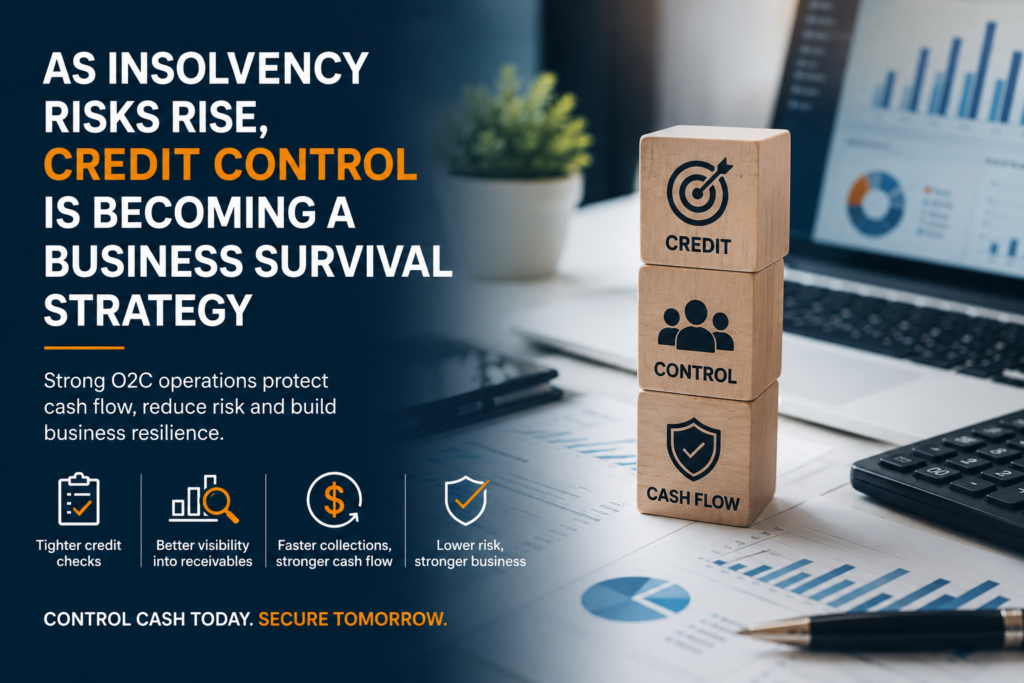
Global insolvencies are expected to rise again in 2026, putting millions of jobs and businesses under pressure. But for many companies, financial stress does not begin with bankruptcy filings — it begins much earlier with delayed customer payments, rising overdue invoices, shrinking cash flow, and weak receivables visibility.
Most businesses do not fail overnight.
The warning signs usually appear quietly inside finance operations: customers asking for longer payment terms, disputes remaining unresolved for weeks, collections slowing down, and finance teams spending more time chasing payments than focusing on strategy.
In stable markets, companies can often absorb these inefficiencies.
But in uncertain economic conditions, poor credit control and weak Order-to-Cash (O2C) operations can quickly become serious financial risks.
This is why businesses across the US and Europe are now placing far greater focus on:
• Customer credit monitoring
• Receivables aging analysis
• Collections efficiency
• Payment behavior tracking
• Dispute resolution timelines
• Cash-flow forecasting
• Working capital visibility
• Customer-risk exposure
Because when bankruptcy risks rise, receivables become risk.
A customer paying 20–30 days late may not seem alarming initially. But across hundreds of accounts, delayed collections directly impact liquidity, supplier payments, payroll planning, operational stability, and borrowing requirements.
According to Allianz Trade, global insolvencies are expected to increase again in 2026, with sectors such as construction, retail, manufacturing, and transportation expected to remain under the highest pressure.
The challenge is that financial stress rarely affects only one business.
When one company delays payments, the pressure spreads across suppliers, vendors, logistics providers, and operational partners. One company’s cash-flow issue quickly becomes another company’s operational challenge.
This is where strong credit control teams and disciplined O2C operations become critical.
Companies that actively monitor customer risk, identify warning signs early, and maintain proactive collections processes are far more likely to protect liquidity during uncertain market conditions.
At the same time, many organizations are realizing that traditional collections processes are no longer enough. Modern O2C operations require better reporting visibility, continuous monitoring, faster follow-ups, stronger controls, and efficient customer communication.
This has also increased interest in offshore O2C support models, particularly in India.
Over the last decade, India has become a major hub for finance and shared-service operations, supporting global organizations across collections, dispute management, cash applications, reporting, and credit operations.
For many US companies, offshore O2C support offers:
• Faster collections follow-ups
• Extended time-zone coverage
• Better receivables visibility
• Improved process consistency
• Scalable operational support
• Stronger focus on working capital management
As economic uncertainty continues into 2026, companies with stronger credit governance and disciplined O2C operations will be far better positioned to maintain stability, protect liquidity, and navigate market volatility successfully.

Related items
For us, Work From Home was never just a trend. It was a smarter way to work — long before
Most agencies don’t really question how low-balance accounts are being worked. They just g
When US collection agencies explore offshore support, the conversation often focuses on hi