
When US collection agencies explore offshore support, the conversation often focuses on highly complex financial portfolios such as credit cards or loan recoveries.
But many agencies are finding that some of the most operationally compatible portfolios for offshore-supported workflows are actually telecom, utilities, and municipal receivables.
These portfolios share a key advantage: they are structured.
Telecom service agreements, utility billing cycles, and municipal citation processes typically follow clearly defined documentation and escalation frameworks. Accounts arise from traceable events—service disconnections, final invoices, equipment non-returns, or parking citations—rather than highly negotiated financial disputes.
That structure allows agencies to build process-driven workflows that can be supported by trained operational teams.
The Scale of Telecom and Municipal Receivables
The opportunity is also driven by volume.
The U.S. telecommunications sector serves hundreds of millions of mobile and internet subscriptions, and service cancellations, device financing balances, and final billing cycles generate a continuous flow of delinquent accounts each year. Similarly, municipalities issue tens of millions of parking and toll citations annually, creating structured receivables that require consistent follow-up and documentation management.
For agencies, these portfolios create large, recurring operational workloads.
Much of that workload sits behind the scenes.
Account verification, documentation review, dispute categorization, payment posting, reporting preparation, and compliance tracking all require disciplined operational support. When portfolio volumes increase, these tasks can place significant pressure on domestic teams.
Why Agencies Are Exploring Offshore Operational Support
Several industry trends are encouraging agencies to rethink how these portfolios are managed.
First, many collection agencies are facing margin pressure as operational costs continue to rise. At the same time, clients expect faster processing, stronger documentation control, and more detailed reporting.
Second, telecom and municipal portfolios tend to involve high-volume, process-driven tasks rather than complex negotiation. This makes them particularly well suited to structured operational environments where standardized workflows can be executed consistently.
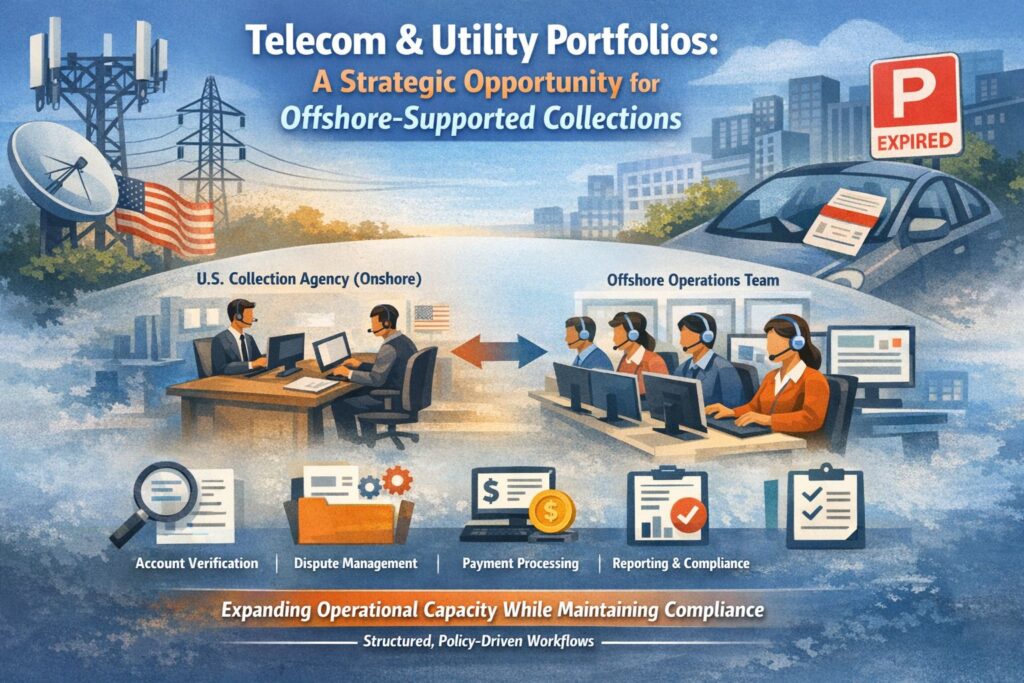
As a result, agencies are increasingly using offshore operational teams to support backend processes such as documentation validation, account status management, reporting preparation, and workflow monitoring.
When implemented within a compliance-led framework, this approach allows agencies to expand capacity without compromising operational oversight.
Maintaining Compliance and Operational Control
For US agencies, compliance and client relationships always remain the top priority.
That is why many offshore models focus on operational augmentation rather than operational replacement. Agencies retain full control over strategy, regulatory oversight, and client communication policies, while offshore teams support defined operational functions within established workflows.
This model allows agencies to maintain their compliance standards while gaining additional operational capacity.
Predictable portfolios such as telecom and utilities benefit particularly well from this structure because the workflows are policy-driven, documentation-based, and repeatable.
How Grow Asia Supports Collection Agencies
Grow Asia works with US agencies by providing dedicated offshore operational teams that integrate with existing workflows.
Rather than replacing internal teams, Grow Asia functions as an extension of the agency’s operational infrastructure, supporting the workflow-heavy processes that telecom and utility portfolios generate.
These teams can assist with:
- Account validation and documentation review
- Dispute categorization and case tracking
- Payment posting and reconciliation support
- Reporting preparation and data management
- Compliance-aligned communication support
- Operational scaling during high-volume periods
This approach allows agencies to expand operational capacity while maintaining leadership control over strategy, compliance, and client relationships.

Related items
Not every account requires premium domestic infrastructure. In today’s collections
If you’re attending ARM Tech, let’s start with one honest question: What are you really tr
Chatbots giving inaccurate advice, algorithms showing bias, and automated systems making d