
Most agencies don’t really question how low-balance accounts are being worked. They just get assigned like everything else.
But when you look closely, a large chunk of most portfolios—often 50–70%—sits under $2,000. These are high-volume accounts that don’t usually require negotiation skill or complex decision-making. What actually drives recovery here is consistency: timely follow-ups, structured outreach, and simply staying on the account.
That’s where the mismatch begins.
In many cases, the same U.S.-based collectors handling high-value or sensitive recoveries are also spending time chasing $800 or $1,200 balances. The outcome doesn’t necessarily improve because of their experience, but the cost of handling those accounts definitely goes up.
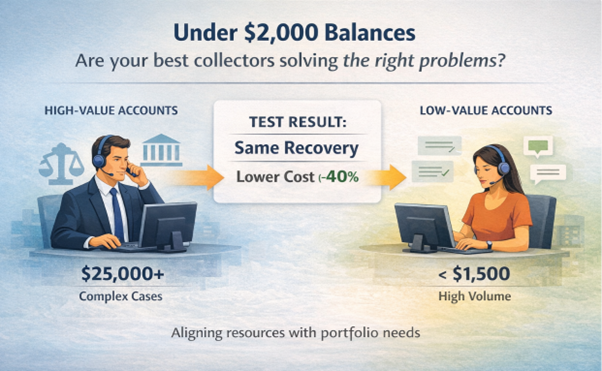
One agency tested this by splitting a low-balance segment under $1,500. Half stayed with their U.S. collectors, while the rest moved to a process-driven offshore team using the same scripts and timelines. After a few months, recovery rates were nearly the same, but the cost per dollar recovered dropped by close to 40%.
That kind of gap forces a different way of thinking.
This is where models like Grow Asia start to fit in—not as a replacement for U.S. collectors, but as a way to rebalance how work is distributed. By supporting high-volume, low-complexity accounts through structured offshore teams, agencies can maintain consistency on these portfolios while allowing their in-house collectors to focus on the accounts that actually require judgment and experience.
It’s not about reducing quality or cutting corners. It’s about aligning the level of effort with the nature of the work.
When that alignment happens, the benefits show up quietly but clearly—better coverage on low-balance accounts, more focus on high-value recoveries, and stronger overall unit economics.
The question, then, isn’t whether your team is capable.
It’s whether you’re using that capability where it actually creates value.
Because in high-volume segments, outcomes are driven less by expertise and more by consistency and coverage.
The real opportunity isn’t to do more— it’s to rebalance.

Related items
Global insolvencies are expected to rise again in 2026, putting millions of jobs and busin
When US collection agencies explore offshore support, the conversation often focuses on hi
Not every account requires premium domestic infrastructure. In today’s collections